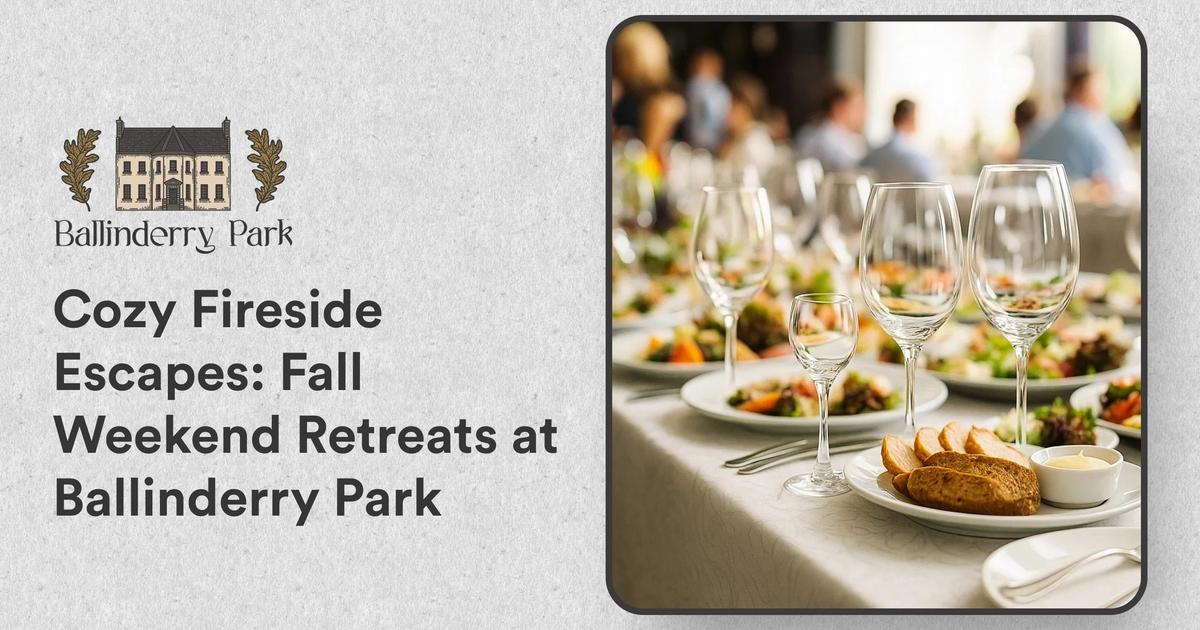
Cozy Fireside Escapes

Rowan Stainsby

Cozy interior at Ballinderry Park
There exists a particular magic in autumn weekends spent by the fire, where the crackle of burning logs becomes a conversation all its own, and the world beyond rain-streaked windows feels delightfully distant. At Ballinderry Park, nestled in the gentle folds of Ireland’s countryside, this magic isn’t merely experienced—it’s carefully cultivated, refined into an art form that gives guests something increasingly rare in our frenetic modern lives: permission to unwind.
The phrase itself carries weight. In an age where productivity has become a moral imperative, where our worth is measured in output and efficiency, the simple act of doing nothing has become almost transgressive. Yet here, surrounded by ancient trees and rolling pastures, beneath skies that shift from pearl grey to slate and back again, Ballinderry Park extends an invitation that feels like absolution: you may rest now. You are allowed to simply be.
This philosophy permeates every aspect of the property, from the architecture to the amenities, from the carefully chosen furnishings to the unhurried pace of days that unfold without agenda or expectation. It’s a place designed not for doing, but for being—for reconnecting with the slower rhythms that our ancestors knew instinctively but that we’ve somehow forgotten in our rush toward an ever-receding horizon.
The Sanctuary of the Drawing Room
The heart of Ballinderry Park’s autumnal appeal beats strongest in the drawing room, where fragrant log fires burn throughout the cooler months. These aren’t the harsh, acrid fires of necessity, but rather carefully tended blazes that fill the air with the sweet, resinous scent of properly seasoned wood. Each log has been selected for its burning properties, its ability to produce not just heat but ambiance—the gentle pop and hiss that provides nature’s own soundtrack to quiet afternoons.
It’s worth noting what these fires are not: they’re not peat fires, despite Ireland’s long tradition of turf-cutting. While peat smoke carries its own nostalgic associations for many, there’s a lightness to a wood fire that better suits Ballinderry Park’s ethos. The scent doesn’t cling to clothes or permeate rooms; instead, it drifts gently through the space, a whisper rather than a shout, present without being overwhelming.
The drawing room itself has been designed with the fire as its focal point. Deep sofas upholstered in sumptuous fabrics face the hearth, positioned at exactly the right distance to feel the fire’s warmth without being overwhelmed by its heat. Side tables hold forgotten novels, their spines cracked from previous readers, while tall windows frame views of the surrounding countryside—a living painting that changes by the hour.
On autumn weekends, when rain patters against the windows and wind rustles through the trees outside, the drawing room becomes a refuge in the truest sense. It’s a space that encourages lingering, that makes time feel elastic and generous. Here, conversations meander rather than march toward conclusions. Books are opened, set aside, picked up again. Tea grows cold in china cups while the fire burns on, indifferent to clocks and schedules.
The Architecture of Comfort
What makes the drawing room particularly effective as a gathering space isn’t any single element, but rather the careful orchestration of multiple details working in harmony. The ceiling height creates a sense of grandeur without sacrificing intimacy. The color palette—warm ochres and deep chestnuts, cream and sage—feels both sophisticated and welcoming. Even the lighting has been considered, with multiple sources creating pools of warmth rather than the harsh uniformity of overhead fixtures.
The bookshelves deserve special mention. They’re not merely decorative, stuffed with leather-bound volumes chosen for their visual appeal. Instead, they’re working libraries, filled with an eclectic mix that suggests genuine curation: classic literature alongside contemporary fiction, local history next to travel memoirs, poetry collections sharing shelf space with nature writing. They’re the kind of shelves that reward browsing, where you might discover a forgotten favorite or stumble upon something entirely new.
The fireplace mantel changes with the seasons. In autumn, it might hold branches of turning leaves, their colors echoing the flames below. Small objects collected from the grounds—an interesting stone, a particularly beautiful piece of weathered wood—join seasonal decorations, creating a display that feels organic rather than staged. This attention to detail, this commitment to authenticity, reinforces the sense that Ballinderry Park is a home rather than merely a property, a living space rather than a static display.
The Cedar Hot Tub: Where Elements Converge
If the drawing room represents Ballinderry Park’s mastery of indoor comfort, the cedar hot tub on the private terrace showcases an equally sophisticated understanding of outdoor sanctuary. This isn’t your standard plastic spa tub, mass-produced and anonymous. The cedar construction connects the experience to nature, the wood grain visible beneath the water’s surface, the natural oils in the timber releasing their subtle scent when heated.
The positioning of the hot tub demonstrates the same careful thought that characterizes the entire property. It sits on a private terrace, screened from neighboring properties but open to views of the surrounding countryside. During autumn weekends, when early darkness falls like a curtain and stars begin to appear in the clearing sky, the hot tub becomes a portal to a different kind of experience altogether.
Picture this: you step from the warmth of your accommodation into the crisp autumn air, goosebumps rising on your skin in the seconds it takes to reach the hot tub’s edge. Then you descend into water heated to precisely the right temperature, feeling your muscles unclench as warmth envelops you. Steam rises from the water’s surface, creating a localized fog that blurs the boundary between where you end and the world begins.
“Soft rains fell outside, sheep were bleating, everything was right in the world.”
This guest’s observation captures something essential about the hot tub experience at Ballinderry Park. It’s not about escaping from the elements, but rather about being immersed in them while remaining comfortably protected. The rain continues to fall, its rhythm on the terrace a meditation all its own. The sheep in nearby fields call to each other, their voices carrying clearly in the damp air. And you, submerged to your shoulders in heated water, exist at the perfect intersection of comfort and exposure, domestic and wild, shelter and storm.
The Science of Hydrotherapy
Beyond the purely sensory pleasures, the hot tub offers genuine therapeutic benefits that complement Ballinderry Park’s wellness-focused approach. The heat dilates blood vessels, improving circulation and delivering oxygen-rich blood to tired muscles. Buoyancy reduces pressure on joints and spine, allowing the body to release tension patterns held throughout the day. The combination of heat and water creates an environment where stress hormones decrease and endorphins rise, a biochemical shift toward relaxation that you can feel in real time.
For many guests, the hot tub becomes a ritualized part of their stay. Perhaps it’s an early morning soak, watching dawn light gradually reveal the landscape, breath visible in the cool air above steaming water. Or an evening session, stars wheeling overhead while you contemplate nothing in particular. Some find it the perfect conclusion to a long walk, muscles pleasantly tired from traversing the countryside. Others use it as a meditative space, the water’s embrace facilitating the kind of deep rest that proves elusive in ordinary life.
The privacy of the terrace ensures these moments remain unobserved and uninterrupted. There’s no self-consciousness here, no awareness of other guests or passing strangers. It’s a luxury that money can buy but that’s increasingly rare: genuine solitude in a beautiful place, time and space to exist without performance or pretense.
The Geography of Disconnection
Ballinderry Park’s rural location isn’t merely scenic—it’s strategically essential to the property’s mission. The tranquil setting provides something that can’t be replicated in urban or suburban environments: true disconnection from the networks and obligations that typically govern our lives. Here, in the countryside’s gentle embrace, the constant pull of the connected world loosens its grip.
The landscape itself encourages a different pace of living. Rolling hills invite wandering rather than destination-focused hiking. Ancient trees suggest time scales that make our urgencies seem suddenly trivial. Fields stretching toward distant horizons remind us that the world is larger and stranger than our daily routines would suggest. This is landscape as therapy, geography as permission structure.
The soundtrack of Ballinderry Park reinforces this sense of otherworldly calm. Instead of traffic noise and human commotion, you hear wind in the trees, rain on the roof, birdsong at dawn. The sheep mentioned in that guest quote aren’t merely picturesque additions to the scenery—they’re part of a soundscape that roots you in this particular place and time, that reminds you you’ve traveled not just in space but into an entirely different mode of being.
The Village Connection
While Ballinderry Park offers comprehensive on-site amenities, its proximity to local villages adds another dimension to the experience. These aren’t tourist traps designed to extract maximum revenue from visitors, but rather authentic Irish communities where life proceeds according to rhythms established over generations. The local pub serves as genuine gathering place, not theme park recreation. The village shop stocks actual necessities alongside tourist provisions. The church still holds regular services, its bells marking time in the traditional way.
For guests who want to venture beyond the property—and not all do—these villages offer a gentle transition between the complete seclusion of Ballinderry Park and the wider world. You can walk to the nearest village, enjoy a pint of Guinness poured properly (which takes time, as it should), and exchange pleasantries with locals who’ve seen enough tourists to be friendly without being obsequious. Then you can walk back, your temporary connection to community satisfied, ready to return to private sanctuary.
This balance between isolation and connection, between complete retreat and gentle engagement, gives guests agency over their own experience. There’s no prescribed itinerary, no sense that you’re failing to make proper use of your time if you spend an entire afternoon reading by the fire. The property offers options without imposing obligations, suggestions without expectations.
Ready to Experience Your Own Fireside Retreat?
Discover the perfect autumn escape at Ballinderry Park
The Rhythm of a Fireside Weekend
What does a typical weekend at Ballinderry Park actually look like? The honest answer is that there’s no such thing as typical—each guest creates their own experience based on their needs and preferences. But there are patterns that emerge, rhythms that many find themselves falling into naturally once freed from the usual constraints of scheduled life.
Many guests report that the first day involves a period of adjustment. You arrive wound tight from travel, from work, from the accumulated stress of ordinary life. Your mind still races with to-do lists and worries, still reaches reflexively for your phone to check messages that don’t actually require checking. The first few hours can feel almost uncomfortable, that fidgety sense that you should be doing something, achieving something, optimizing something.
Then something shifts. Maybe it happens during your first soak in the hot tub, muscles unclenching in the heated water. Maybe it occurs as you sit by the drawing room fire, watching flames dance while rain drums against windows. Or perhaps it comes during a walk through the grounds, your pace gradually slowing until you’re moving at a speed that would seem absurdly leisurely in your normal life but that feels exactly right here.
Morning Rituals
Mornings at Ballinderry Park often begin slowly, luxuriously. Without alarm clocks dictating your waking hours, you rise when your body decides it’s ready—a simple pleasure that feels almost subversive for those accustomed to being jolted into consciousness by electronic shrieking. The first sounds you hear are natural: birdsong, wind in the trees, perhaps the distant lowing of cattle.
Coffee or tea taken in bed, looking out at morning light illuminating the landscape, becomes not a rushed prelude to productivity but an activity worthy of attention in its own right. You might watch fog lifting from the fields, revealing the landscape in stages like a slow-motion curtain rising. Or witness rain sweeping across the countryside in visible sheets, nature’s own performance art.
Breakfast, when you finally rouse yourself to prepare or collect it, isn’t grabbed hastily between other tasks but enjoyed with the attention it deserves. There’s time to notice flavors, textures, the way butter melts into warm bread, the precise balance of your coffee or tea. Eating becomes an act of mindfulness rather than mere fuel consumption.
After breakfast, the day opens up with delicious ambiguity. You might take a walk, exploring the grounds and nearby countryside. Or settle into the drawing room with that book you’ve been meaning to read for months. Perhaps return to the hot tub, finding that a morning soak offers different pleasures than an evening one. The point isn’t what you do, but rather that you’re choosing based on genuine desire rather than obligation.
Afternoon Contentment
Afternoons at Ballinderry Park possess a particular quality of timelessness. Clock time continues to advance, obviously, but subjective time becomes elastic, stretching and contracting based on engagement rather than external markers. An hour spent absorbed in a good book by the fire can feel like twenty minutes. Twenty minutes in the hot tub, watching clouds drift across the sky, can feel like an entire afternoon.
This temporal distortion isn’t disorienting—quite the opposite. It’s liberating to exist outside the tyranny of the schedule, to move through the day guided by internal rhythms rather than external demands. When you’re hungry, you eat. When you’re tired, you rest. When you want movement, you walk. When you crave stillness, you sit by the fire and do absolutely nothing.
Many guests find themselves napping in the afternoon, something they might not have done since childhood. These aren’t the desperate, exhausted crashes of the severely sleep-deprived, but rather the gentle drifting-off that comes from being genuinely relaxed, from existing in a space where sleep is permitted rather than scheduled. You might doze on the sofa by the fire, lulled by its warmth and the soft sounds of the house. Or burrow under blankets in your comfortable bed, rain pattering on the windows like nature’s own lullaby.
Evening Enchantment
As daylight fades and evening arrives, Ballinderry Park reveals yet another aspect of its character. Lamps are lit throughout the drawing room, creating pools of warm light that push back the darkness without banishing it entirely. The fire, perhaps stoked and replenished, burns brighter in the gathering gloom, its light dancing on walls and ceiling.
Evening is when the hot tub experience becomes particularly magical. The contrast between cold air and hot water intensifies. Stars emerge overhead if the clouds permit, their light reaching you from distances and durations that make human concerns seem charmingly insignificant. Steam rises from the water in thick clouds, creating an intimate cocoon that contains just you and this moment.
Dinner might be prepared in your accommodation’s kitchen, using local ingredients that taste unmistakably of this place. Or you might venture to a nearby village for a meal at a traditional pub, where the food is honest and generous and the atmosphere welcomes newcomers without making a fuss about them. Either way, there’s no rush, no sense that you need to be somewhere else or doing something else.
The evening often ends where the day began: in bed, but this time with the pleasant tiredness that comes from genuine relaxation rather than exhaustion. Sleep comes easily here, deep and untroubled, the kind of rest that actually restores rather than merely interrupting wakefulness. And when you wake the next morning, you get to do it all again, discovering new variations on the theme of unhurried living.
The Architecture of Comfort: Accommodation Details
While the philosophy and setting of Ballinderry Park provide the framework for transformation, the actual accommodations deserve their own consideration. These aren’t hotel rooms, anonymous and interchangeable. They’re distinctive spaces, each with its own character and charm, designed to support the property’s mission of giving guests permission to unwind.
The accommodations feature what might be called “considered comfort”—every element has been chosen not just for aesthetic appeal but for its contribution to the overall experience of relaxation. Beds aren’t merely adequate but genuinely excellent, with high-quality mattresses and linens that make sleeping a pleasure rather than a necessity. Furniture is positioned to take advantage of views while creating intimate spaces within larger rooms.
Texture and Tactility
One notices immediately the attention paid to how things feel, not just how they look. Throws draped over sofas invite touching, their weave substantial without being heavy. Cushions actually cushion, filled properly rather than skimped. Rugs underfoot provide warmth and softness, making you want to walk barefoot even in cooler weather. These textural choices create an environment that’s physically comforting, that invites you to settle in and stay awhile.
The color palettes in the accommodations echo the natural world visible through the windows. You’ll find the soft greys of cloudy skies, the warm browns of turned earth, the deep greens of evergreens, the golden tones of autumn grasses. These aren’t bold, statement-making colors but rather subtle, sophisticated shades that create calm rather than excitement, that support rest rather than stimulation.
Windows are generously sized, bringing the landscape inside without sacrificing privacy. During the day, natural light fills the spaces, changing in quality and intensity as weather patterns move through. At night, those same windows become mirrors reflecting the warmth of interior lighting, creating a sense of secure enclosure while maintaining connection to the world beyond the glass.
Kitchen and Living Spaces
The kitchens in Ballinderry Park accommodations strike an ideal balance between functionality and homeliness. They’re genuinely usable if you want to cook, with proper equipment and adequate workspace. But they’re also optional—you’re never made to feel that you must prepare meals if you’d rather not. This flexibility supports different styles of retreat, from the completely self-sufficient to the prefer-to-be-served.
Living areas avoid the common pitfall of looking good while being uncomfortable. Sofas are deep enough to curl up in, positioned to facilitate conversation or support solitary reading with equal ease. Side tables appear exactly where you need them, ready to hold a teacup or wine glass or the book you’ve just set down. The rooms feel lived-in rather than staged, comfortable rather than precious.
Technology is present but not prominent. WiFi is available for those who need it, but there’s no pressure to stay connected. Televisions exist for those who want them but don’t dominate the space. The design philosophy seems to be: “We provide these modern amenities, but we won’t be offended if you ignore them entirely in favor of conversation, reading, or simply staring into the fire.”
Your Perfect Autumn Weekend Awaits
Book your cozy retreat at Ballinderry Park today
The Healing Power of Permission
At its core, what Ballinderry Park offers isn’t just a collection of amenities—though the fragrant fires, cedar hot tub, and comfortable accommodations certainly contribute to the experience. What the property really provides is something more subtle and perhaps more valuable: explicit permission to prioritize your own wellbeing, to step away from productivity and performance, to simply exist without justification or agenda.
This permission structure matters more than might be immediately obvious. Many of us carry deep-seated beliefs about rest being something that must be earned through exhaustion, that relaxation is acceptable only after all tasks are completed (which, of course, they never are). We’ve internalized the notion that our worth derives from our output, that idle time is wasted time, that self-care is selfish indulgence rather than necessary maintenance.
Ballinderry Park challenges these beliefs not through lectures or programs but through environment and atmosphere. The property itself makes an argument: this is good and right and proper. You should be here, doing nothing in particular, enjoying the fire and the hot tub and the simple pleasure of existing in a beautiful place. There’s no need to justify this. You don’t have to earn it through prior suffering or promise future productivity to make it worthwhile. It’s enough that you’re here now, resting, unwinding, being.
The Compound Effect of Rest
What becomes apparent to many guests, particularly those who visit repeatedly, is that the benefits of a weekend at Ballinderry Park extend well beyond the immediate experience. Yes, you feel relaxed and refreshed during your stay—that’s obvious and immediate. But something more subtle occurs as well: a recalibration of your relationship with rest itself.
After experiencing genuine, guilt-free relaxation, the rushed and inadequate rest attempts of ordinary life reveal themselves as the poor substitutes they are. You begin to question why you ever thought that scrolling through social media for twenty minutes before bed counted as unwinding, or that a weekend spent catching up on chores was a break from work. You develop standards, expectations that the rest of your life must now attempt to meet.
Many guests report that they return home not just refreshed but transformed in their approach to self-care. They begin protecting their time more zealously, creating boundaries that previously seemed impossible. They recognize that rest isn’t something that happens automatically in available time but must be actively chosen and defended. They carry something of Ballinderry Park’s philosophy back into their daily lives, giving themselves permission to unwind even in environments that don’t explicitly offer it.
Seasonal Considerations: Why Autumn?
While Ballinderry Park offers appeal year-round, there’s something particularly special about autumn weekends at the property. The season itself conspires to enhance every aspect of the experience, from the practical to the atmospheric.
The practical benefits are straightforward: autumn weather makes both the fireside and hot tub experiences optimal. The fires that might feel merely decorative in summer become genuinely welcoming when there’s a chill in the air. The hot tub, pleasant any time of year, becomes transcendent when you’re immersed in heated water while cool autumn air raises goosebumps on your exposed shoulders and head.
But autumn offers more than just ideal conditions for the property’s amenities. The season itself carries a particular emotional resonance, a melancholy beauty that encourages introspection and appreciation. The landscape transforms daily, leaves turning from green to gold to rust to bare branches, a visible reminder of impermanence and change. This natural meditation on transformation and letting go mirrors the internal process that many guests experience during their stay.
The Light Quality
Autumn light in Ireland possesses a unique quality, lower and more golden than summer’s brightness, more generous than winter’s stingy rations. It slants through windows at dramatic angles, creating patterns that move across walls and floors as the day progresses. This changing light animates interior spaces, making even stillness feel dynamic, turning ordinary rooms into stage sets for your own private dramas of rest and renewal.
The interplay between light and weather becomes its own form of entertainment. You might watch rain clouds approach across the fields, the light changing from bright to dim as they pass overhead, then brightening again as they move on. Or witness that peculiar Irish phenomenon where it rains while the sun still shines, creating rainbows that arc across the property with almost absurd beauty.
These atmospheric variations support the kind of contemplative observation that we rarely make time for in ordinary life. You find yourself actually watching weather patterns, noticing how wind moves through trees, tracking the progress of clouds across the sky. This attention to the natural world’s minute variations becomes its own form of meditation, a practice that quiets the mind without requiring any special technique or training.
The Social Dimension: Sharing Silence
While much of this discussion has focused on solitary experiences—solo soaks in the hot tub, individual contemplation by the fire—Ballinderry Park also excels as a destination for couples or small groups. The property’s design supports a particular kind of togetherness: present with others without requiring constant interaction, sharing space and experience without demanding conversation.
For couples, Ballinderry Park offers a rare opportunity to exist alongside each other without agenda. There’s no pressure to maintain constant dialogue or engineer romantic moments. Instead, you might read separate books by the fire, occasionally sharing a passage or thought. Or soak together in the hot tub in comfortable silence, watching stars emerge overhead. These quiet, pressure-free times together can feel more intimate than elaborately planned date nights, creating connection through shared presence rather than performed romance.
Small groups discover that the property supports both collective and individual time with equal ease. You might gather in the drawing room for conversation, then scatter to your preferred activities without anyone feeling abandoned or antisocial. The friend who wants a long walk and the one who prefers to nap can both honor their preferences without requiring compromise or negotiation. When you reconvene for dinner or an evening by the fire, you’re refreshed by having followed your own rhythms rather than exhausted from trying to synchronize incompatible needs.
The Gift of Parallel Play
Child development specialists speak of “parallel play,” the stage where children play alongside each other without directly interacting. It’s a precursor to more complex social interaction, but it’s also valuable in its own right—a way of being social without the demands of full engagement. Ballinderry Park facilitates a sophisticated adult version of parallel play, where you can be with others while still maintaining your own experience.
This might look like two people in the same room, one reading while the other sketches or journals. Or a group in the hot tub, each lost in their own thoughts while still part of the collective experience. There’s no pressure to perform social connection, no anxiety about whether you’re being entertaining enough or engaged enough. You can be exactly as social or solitary as feels right in each moment, and that freedom itself becomes bonding.
For relationships strained by the constant demands of coordinated living—couples managing careers and children and households, friends trying to schedule time together around packed calendars—this permission to exist separately while together can feel revolutionary. It removes the pressure that can make planned social time feel like just another obligation, replacing it with the ease of organic connection and genuine choice.
Experience the Magic of Fall at Ballinderry Park
Reserve your fireside retreat and discover what it means to truly unwind
Practical Considerations for Your Visit
Having explored the philosophical and experiential aspects of a Ballinderry Park autumn weekend, it’s worth addressing some practical considerations that will help you make the most of your visit.
What to Pack
The key to packing for Ballinderry Park is embracing comfort over style. This isn’t a place where you need to dress to impress—quite the opposite. Bring clothes that feel good, that you can move and breathe and relax in. Layers are essential for Irish autumn weather, which can shift from warm to cool, dry to wet, calm to blustery within a single afternoon.
Essential Items:
- Comfortable indoor clothing (you’ll spend significant time in the accommodation)
- Warm robe or oversized cardigan for moving between hot tub and indoors
- Waterproof jacket and sturdy walking shoes if you plan to explore
- Books, journal, or other analog entertainment
- Swimwear for the hot tub (obvious but easily forgotten)
Optional but Recommended:
- Preferred tea or coffee if you’re particular about your morning brew
- Favorite snacks or treats
- Slippers (for ultimate indoor comfort)
- Portable speaker if you want your own music
- Binoculars for wildlife watching
Planning Your Time
The most important advice about planning your time at Ballinderry Park is this: don’t. Or at least, don’t overly plan. The whole point is to escape the tyranny of the schedule, to allow your days to unfold organically based on desire rather than agenda. That said, a few considerations can enhance your experience without constraining it.
Arrive earlier in the day if possible. This gives you time to settle in, to begin the unwinding process, to establish your presence in the space before evening arrives. There’s something about unpacking in daylight, exploring the accommodation and grounds while you can still see clearly, that helps you feel oriented and at home.
Consider staying at least two nights, preferably three. The first day often involves that adjustment period, the transition from ordinary life to retreat mode. It’s on the second day that you really settle into the rhythm, that you begin to feel the full benefits of being there. A third day allows you to fully enjoy that settled state before the necessary disruption of departure.
If you’re visiting with others, discuss expectations beforehand. Are you expecting to spend all your time together, or will there be periods of independent activity? Will you cook together or separately? Are there any activities everyone definitely wants to do? Having these conversations in advance prevents misunderstandings and allows everyone to relax into the experience.
Making the Most of the Hot Tub
The cedar hot tub deserves special mention when it comes to maximizing your experience. A few tips based on guest feedback and best practices:
Don’t wait until late in your stay to try it. Some guests save the hot tub for a special treat, only to discover on their last evening that they wish they’d been using it all along. Try it early, then you can decide how often you want to return to it.
Experiment with different times of day. Morning soaks offer a gentle way to wake up and greet the day. Afternoon sessions can break up longer periods of indoor time. Evening and night soaks provide their own magic, especially if the weather cooperates with clear skies and visible stars.
Bring water with you. Hot tubs are dehydrating, and while you’re blissfully soaking, you may not notice your body’s need for hydration until you emerge feeling light-headed. A water bottle within reach prevents this and allows you to extend your soak comfortably.
Don’t feel obligated to stay in for any particular duration. Sometimes fifteen minutes is exactly right. Other times you might soak for an hour or more, lost in thought or conversation. Listen to your body and honor what feels good rather than adhering to some imagined ideal hot tub session length.
Beyond the Property: Optional Explorations
While Ballinderry Park provides everything needed for a complete retreat experience, some guests enjoy venturing beyond the property to explore the surrounding area. These excursions can enhance your stay without disrupting its essential character of rest and disconnection.
Walking Routes
The Irish countryside surrounding Ballinderry Park rewards exploration on foot. These aren’t demanding hikes requiring special equipment or advanced fitness—they’re walks, gentle rambles that allow you to move through the landscape at a pace that permits actual observation and appreciation.
Local roads with minimal traffic provide ready-made routes. You can simply step out the door and start walking, following minor roads that wind between fields and through small stands of trees. These roads often feel more like paths, quiet enough that the sound of your own footsteps becomes noticeable, that birdsong and wind and the occasional bleating sheep provide the soundtrack.
The landscape’s gentle topography means you’re rarely faced with challenging climbs or descents. Instead, you move through rolling countryside, over small rises and down into shallow valleys, the views constantly shifting as you progress. Every turn reveals a new configuration of fields and trees and sky, a fresh composition that exists only for this moment before you move on.
Local Villages
The nearby villages offer their own quiet charms for those interested in experiencing authentic Irish rural life. These aren’t tourist destinations with shops selling shamrock keychains and leprechaun dolls. They’re working villages where the post office and pub and church serve actual community needs, where the shop stocks toilet paper and bread alongside the tea and biscuits.
The pubs deserve particular mention. These aren’t themed Irish pubs created for tourists, but genuine local gathering places where the same people have been coming for years or decades. The bartender knows everyone’s usual order. Conversations touch on local matters—the weather, upcoming hurling matches, the new priest or schoolteacher. As a visitor, you’re welcomed without being made a fuss over, included without being the center of attention.
Order a pint of Guinness and prepare to wait. A properly poured pint takes time, can’t be rushed, shouldn’t be rushed. This isn’t inefficiency but rather respect for the product and the process. You can watch the ritual of the two-part pour, the settling, the topping-off that creates the perfect head. Then you can taste the difference that proper pouring makes, understanding why this matters.
The Environmental Consciousness
One aspect of Ballinderry Park worth highlighting is its thoughtful approach to environmental stewardship. This isn’t the kind of performative “green” marketing that slaps a sustainability label on business as usual. Instead, it’s a genuine integration of environmental consciousness into the property’s operation and philosophy.
The use of log fires rather than peat represents one aspect of this approach. While peat has traditional significance in Ireland, its harvesting raises environmental concerns. Peat bogs are important carbon stores and habitats for rare species. By using sustainably sourced wood instead, Ballinderry Park honors Irish heritage while acknowledging contemporary environmental realities.
The cedar hot tub similarly reflects thoughtful material choices. Cedar’s natural properties—resistance to decay, natural antibacterial qualities, pleasant aroma—mean fewer chemicals are required to maintain water quality. The wood itself comes from sustainable forests, renewable rather than extractive.
Throughout the property, you notice this pattern: choices that honor both guest experience and environmental responsibility. It’s never presented heavy-handedly, never used to guilt guests into particular behaviors. Instead, it’s simply how things are done here, seamlessly integrated into the overall experience.
The Ethics of Rest
There’s also something to be said about the environmental ethics of rest itself. In a culture that fetishizes constant productivity and endless growth, that measures success by accumulation and consumption, choosing to simply be—to rest, to observe, to exist without constant acquisition or achievement—becomes a quietly radical act.
Ballinderry Park facilitates this quieter, less extractive mode of being. A weekend here doesn’t require flights to distant destinations or extensive consumption of resources. The pleasures offered are largely non-consumptive: watching fire, soaking in heated water, reading books, walking through countryside. You leave behind no trail of waste, no environmental damage, just footprints that the next rain will wash away.
This isn’t to suggest that Ballinderry Park is somehow morally superior to other forms of travel or recreation. Rather, it’s to note that the property’s philosophy naturally aligns with lower-impact forms of leisure, that its emphasis on being over doing results in lighter environmental footprint almost as a side effect.
Begin Your Journey to Restoration
Book your cozy autumn weekend at Ballinderry Park
The Return: Carrying It With You
All retreats must end. Eventually, the calendar asserts itself, obligations call, and it’s time to pack your bags and return to ordinary life. The transition can feel jarring—from the unhurried spaciousness of Ballinderry Park to the compressed, scheduled urgency of normal existence. But the experience doesn’t simply evaporate once you depart.
Many guests report that they carry something of Ballinderry Park with them after leaving. It might be a heightened awareness of how different genuine rest feels compared to the inadequate substitutes we usually settle for. Or a new understanding of what they actually need to unwind—perhaps discovering that scrolling through social media provides nothing like the restoration of sitting quietly by a fire.
Some find themselves more protective of their time after visiting, more willing to say no to obligations that don’t serve them, more intentional about creating spaces for rest in their daily lives. The property doesn’t just provide a weekend of relaxation but models what prioritizing wellbeing can look like, giving guests a template to carry forward.
Creating Rituals
One practical way guests extend the Ballinderry Park experience is by creating home rituals inspired by their stay. This might be as simple as lighting candles in the evening, mimicking the soft lighting that made the drawing room so welcoming. Or establishing a regular practice of unplugging completely for a few hours, recreating that sense of genuine disconnection.
For those fortunate enough to have access to baths or hot tubs at home, the evening soak can become a regular practice rather than a special-occasion luxury. The key is approaching it with the same intentionality experienced at Ballinderry Park—not rushing through it as just another task to check off, but rather treating it as genuine self-care time, protected and valued.
Others focus on recreating the permission structure that Ballinderry Park provides so explicitly. They might tell themselves, out loud if necessary: “I have permission to rest. I don’t need to earn this. It’s okay to do nothing.” This verbal reminder can help overcome the internalized voices that insist rest must be justified through exhaustion or future productivity.
The Long View
Perhaps most significantly, a weekend at Ballinderry Park can shift your long-term perspective on what matters. When you’ve experienced the profound satisfaction of existing in a beautiful place without agenda or achievement, when you’ve felt the deep rest that comes from giving yourself permission to unwind, it becomes harder to accept the grinding exhaustion of overwork as normal or inevitable.
You might find yourself questioning assumptions you’ve held about what constitutes a successful life. Does success really require constant striving, perpetual productivity, achievement at the cost of wellbeing? Or might there be wisdom in the older understanding that life includes both activity and rest, both doing and being, both achievement and appreciation?
These aren’t questions that Ballinderry Park explicitly poses—there are no seminars or workshops, no facilitated discussions about life priorities. But the experience itself raises them, gently and persistently. And in answering them for yourself, you might discover that your time at the property marked not just a pleasant weekend away, but the beginning of a more fundamental reorientation toward what truly matters.
Conclusion: The Gift of Unwinding
In the end, what Ballinderry Park offers can’t be reduced to its amenities, however excellent they may be. The fragrant log fires, the cedar hot tub, the comfortable accommodations, the tranquil rural setting—all of these contribute to the experience, but they’re means rather than ends. What the property truly provides is something simultaneously simpler and more profound: space and permission to be fully yourself, unhurried and unobserved.
In a culture that increasingly treats rest as weakness and stillness as wasted opportunity, Ballinderry Park makes a quiet but powerful counter-argument. It suggests that we are not merely machines requiring occasional maintenance to maximize output, but rather human beings with needs for beauty, comfort, connection, and rest. It demonstrates that these needs deserve to be honored not grudgingly but generously, not after everything else is finished but as priorities in their own right.
The property’s mission—to give people permission to unwind—might seem modest at first glance. Permission, after all, is just words, just an attitude. But for many of us, trapped in patterns of overwork and under-rest, constantly striving and never arriving, that permission represents something revolutionary. It’s the key that unlocks the possibility of a different relationship with ourselves and our time, one based on care rather than extraction, on wholeness rather than productivity.
A weekend at Ballinderry Park won’t solve all your problems or transform your life overnight. You’ll still return to the same obligations and challenges that filled your pre-visit existence. But you’ll return changed nonetheless, carrying the memory of what genuine rest feels like, the knowledge that another way of being is possible. And in that memory and knowledge lies the seed of something significant: the understanding that you deserve rest not as reward but as right, not as luxury but as necessity.
So when autumn arrives with its shorter days and longer nights, when the world turns golden and red and brown, when rain patters on windows and wind rattles branches, consider what Ballinderry Park offers. Consider sitting by a fragrant fire while soft rain falls outside and sheep bleat in distant fields. Consider soaking in heated water under darkening skies, steam rising around you, tension melting from muscles held tight too long. Consider giving yourself permission to unwind, fully and without guilt, in a place designed precisely for that purpose.
The fire will be burning. The hot tub will be ready. The drawing room awaits. And you—tired, stressed, perpetually rushing you—you deserve this. You don’t need to earn it or justify it. You simply need to accept the invitation, to step away from the demands that will still be there when you return, to discover what happens when you finally, truly, deeply rest.
Everything will be right in the world. For a weekend, at least. And sometimes that’s exactly enough.
Your Fireside Retreat Awaits
Discover the profound peace of Ballinderry Park this autumn
About the Author

Rowan Stainsby
Rowan is a marketing professional and founder of Kraft Digital Agency. In 2024, he and his wife Laoise purchased Ballinderry Park, a stunning Georgian house dating back to c.1740 in County Galway. Together, they are passionately restoring this historic property and documenting the journey on their YouTube channel 'Call of the Curlew'. With a vision to create a space where busy people can unwind, Rowan oversees the transformation of Ballinderry Park into a luxury destination for stays, weddings, and events while honoring its remarkable 700-year heritage.